

CJ’s Weekly Market Memo
Zweig’s Second Rule
September 19, 2026
Marty Zweig left investors two rules and most people only remember the first one. Don’t fight the Fed, they forget don’t fight the tape. He wanted both satisfied before he would own stocks with conviction. That is the discipline I describe here as my two confirmations fundamental and technical. Kevin Warsh raised rates a quarter point on Wednesday, the first hike in three years. Followed blindly, the first rule now reads plainly against equities. The question this letter asks is whether I should obey it. Zweig’s rule was never about the funds rate by itself; it was about the economic structure that carries the cost of money into corporate earnings and household spending. And the rule only works as well as that system holds. My view is that the mechanism is no longer as workable for the current market as represented by the S&P 500 index. So, the second rule, the one about the tape, is the one governing my behavior this week. The near-term history is against me, and the chart below shows it clearly.
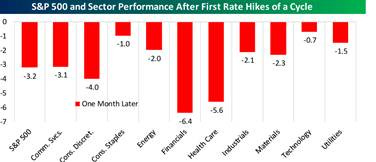
Average S&P 500 and sector performance one month after the first hike of a tightening cycle, six cycles since 1994. Source: Bespoke Investment Group.
Market Fundamentals
The Fed tightened into an economy that is still growing, and that part of Zweig’s first rule I take seriously. The committee voted unanimously on Wednesday and futures market pricing points to at least one more increase before year end. That would make this a cycle rather than a gesture. Bespoke counts it as the seventh tightening start since the modern Fed began in 1994, and in the month after the first hike of the prior six the S&P 500 fell on all but one occasion. Financials took the worst of it and technology barely moved. Six observations is a small sample and I wouldn’t build a portfolio solely on it. But the pattern is consistent enough that ignoring it would be careless. I’m cautious over the next several weeks and the Fed is a good part of the reason.
Where I part company with the rule is on what a hike can actually reach. Rate increases work on the economy by raising the cost of borrowing and by squeezing consumer households. The S&P 500 we own today is not built out of borrowers and households the way it was when Zweig was writing. Bespoke puts the combined weight of the two consumer sectors in the S&P 500 at 13.5%, down from better than 30% before the dot-com boom. The lowest reading on record. The companies that have taken their place fund capital spending out of operating cash flow and sit on net cash. That makes a quarter point on the short rate close to irrelevant for their earnings power. Index earnings are growing at roughly 28%, driven by that same group, and I can’t see the mechanism by which Wednesday’s move slows that materially over the next two quarters. The consumer, meanwhile, is still spending, with August retail sales well ahead of forecast. He may slow from here, and if he does the damage lands on the economy well before it lands on the index.
Inflation is the piece of this that won’t resolve on the Administration or the Fed’s schedule. It runs directly through oil. Crude finished the week above one hundred dollars, and the more damaging number is in the products, where diesel trades at an extraordinary premium to crude. Renewed strikes on Russian refining, and refinery outages here at home, contribute to the problem. Almost everything an American consumer buys spends part of its life on a truck, so a diesel price at these levels is a tax that directly affects the price of goods. Of course, that is on a lag and holds the year-over-year comparisons up. That argues for higher rates for longer no matter what the monthly data prints. Adding to that, the bond market agrees, with the two-year to ten-year spread flattened to the low end of its range for the year. I’m watching the diesel crack and front-month crude more closely than anything out of Washington. If crude comes back under ninety and those premiums narrow, the inflation problem eases. The October meeting becomes a genuine question rather than a foregone conclusion, and the fundamental case improves quickly. If instead, the large technology companies guide their capital plans lower in October because money has gotten expensive, then the tightening Fed policy effect stays intact, and both maxims are clearly in agreement.
Market Technicals
The tape is the rule that has been in effect, and it hasn’t improved. Last week I wrote that participation was draining out of a market whose index level had barely moved, and another week of trading added to that evidence rather than subtracting from it. The Dow Transports broke below their 200-day moving average on Friday for the first time in nearly a year. The semiconductors, which Bespoke calls the “transports of the 21st century” and which I treat as the leadership group of this cycle, spent the week pressed against their 50-day average and after multiple attempts since July failed to clear it once more. The major banks and brokers all finished below their 50-day averages after a hard week, which is the sector the first-hike record says gets hit hardest, and they weakened as expected. The equal weighted S&P 500 index has broken the rising channel it held from April through August. There’s one exception to all of this, and it is the reason I currently expect to be a buyer of stocks later this year.
The exception is the group the Fed cannot reach. The Mag 7 ETF made a new all-time intraday high on Friday while the large cap ex-Mag 7 ETF closed solidly below its 50-day average for the first time since the Iran war began. I read that divergence as the tape agreeing with the fundamentals. Money isn’t leaving this market so much as concentrating in the companies whose earnings don’t depend on the cost of money, which is what you’d expect to see if Zweig’s first rule has lost its grip on part of the index. It’s the least reassuring way to remain bullish, because narrow leadership is still narrow leadership. Still, I’m a strong believer in letting the market tell me what to do rather than me telling the market what to do.
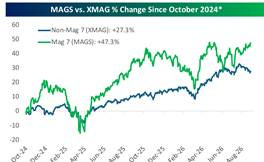
Mag 7 (MAGS) versus large cap ex-Mag 7 (XMAG), total change since October 2024. Source: Bespoke Investment Group.
The key is the semiconductor index and its 50-day average. If the semis clear that line and hold it, the rest of the tape has a path higher and I’ll read this month as a “correction in time” rather than the front edge of something worse. If instead the Mag 7 roll over and join the transports and the banks below their own averages, the one group standing between this market and a real decline has given way. And I’ll act accordingly as long experience has taught me that market prices move well in advance of economic fundamentals.
Prognostication
My two confirmations agree about the next month and disagree about later in the year. The Fed and the tape both say the weeks ahead are unfriendly, which is why I still expect the low for this move in the middle of October, the same call I made in the last two letters. The two, technicals and fundamentals, differ on what that low will represent. The tape, read strictly, describes a distribution process that could carry further than an ordinary seasonal decline. The earnings data describes a pause inside an expansion that’s still intact. When my confirmations split this way the honest response is to hold the timing with conviction and the severity loosely, which means I’m a buyer into October weakness and never a seller into it.
Sentiment supports that posture. AAII bearish readings crossed back above 50% this week to their highest level since the tariff tantrum of 2025. The bulls fell under 30% for the first time in a year. Readings at those extremes have been a reliable intermediate-term contrarian signal for most of my career.
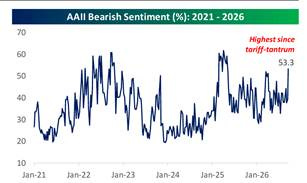
AAII bearish sentiment, weekly, 2021 to 2026. Source: Bespoke Investment Group.
The year to look at is 1994. Greenspan raised rates for the first time in five years on February 4 of that year and then doubled the funds rate over the following twelve months, into an accelerating economy. The bond market absorbed nearly all of the damage, Orange County and the Mexican peso broke, and equity investors got twelve months of chop that ended near where it started. No economic contraction, no bear market, just a year of frustration, and then 1995 returned better than 34%. That’s the shape I expect here, a sloppy market working out whether the Fed has made a mistake, resolving higher once earnings season shows the companies carrying the index still compounding. Coincidentally, 1994 was a midterm year as well.
My list of demands going into October is short: crude back under ninety with a narrower diesel crack, the ten-year below five percent, the semis clearing their 50-day average and holding it, and the third quarter capital spending guidance that starts arriving in the middle of the month. I’d add AAII bulls back above 40%, which would tell me the contrarian case has been spent. Until they show up I intend to do very little, keep my buy list current, and buy weakness rather than wait for an all clear that never sounds until prices have recovered. Stay invested, stay diversified, and don’t fight the tape. Zweig’s first rule will have my attention again when the Fed can reach these earnings, and not a day before.
CJ Brott
Chairman Emeritus, Capital Ideas
The material presented is for informational purposes only and is believed to be accurate. Sources include but are not limited to publications by FactSet, Dow Jones, Yardeni Research, and Bespoke Investment Group. All expressions of opinion reflect the judgment of the author as of the date of publication and are subject to change. The author may hold positions in securities mentioned in this commentary.