

CJ’s Weekly Market Memo
This Time It’s Different
November 7, 2026
In the decades I have spent as a professional investor, trader and advisor to others I have learned that sharp selloffs are almost always caused by the same thing. Leverage, always leverage. Bad news may start a decline, but borrowed money turns it into a rout. A margin call must be met quickly with collateral sold at any price. For several weeks I have warned readers that the AI leaders were vulnerable to such a washout. I expected it in mid-October, and later around the earnings reports of the trillion-dollar companies. Instead, it arrived Thursday after the elections and it was every bit as severe as I feared. Bespoke calculates that since their October peak $5.3 trillion of market value has been erased from roughly twenty of the largest AI related companies. The popular conclusion driving this selloff is the AI boom has ended. I read the week differently. What collapsed was the collateral behind the borrowed money in the AI trade, both the companies’ debt and the investors’ own. The earnings that support those companies remain intact.
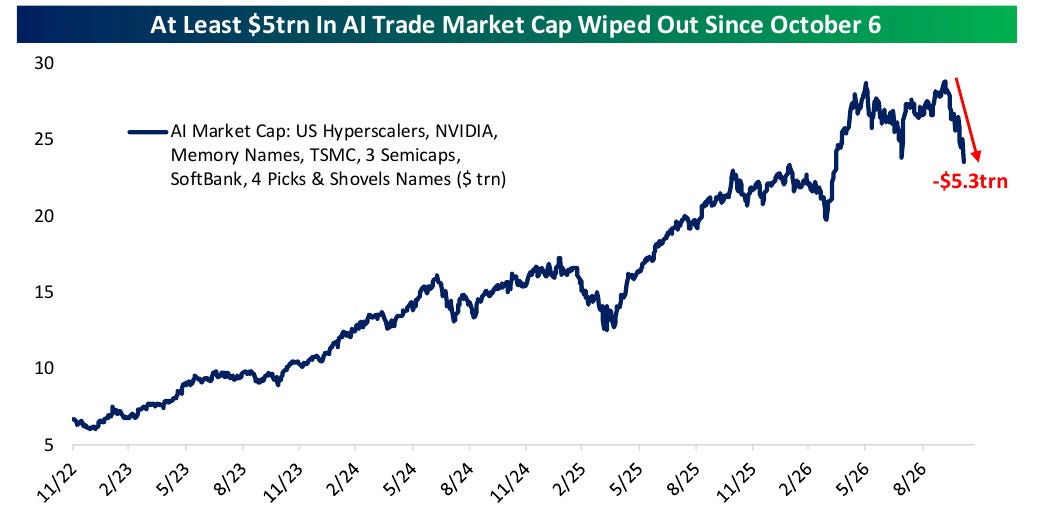
Market value of roughly 20 of the largest AI related companies, down $5.3 trillion since October 6. Source: Bespoke Investment Group.
Market Fundamentals
The economy remains very strong. October payrolls rose 165,000, far above forecasts, and the two prior months were revised higher. Unemployment edged lower, and the hiring was broad, led by professional and business services, health care and transportation. Wages are starting to rise again though over the past year pay has still trailed consumer prices. This looks to me more like an expanding economy rather than one approaching recession.
Corporate earnings tell the same story. FactSet’s consensus calls for S&P 500 earnings growth to slow next year from this year’s extraordinary pace. They still expect growth of 16%, a phenomenal number, well above the average of the past decade. Bespoke shows the capital spending of the five hyperscalers more than doubling from a year ago. Their spending beat the consensus forecast, and none of them lowered guidance. In addition, Goldman Sachs estimates AI investment at close to 2% of US GDP this year, rising toward 3% by 2028. Yet on Thursday the S&P 500 suffered its worst session since the Liberation Day tariff announcements. That was the same day forward earnings estimates for the index reached a new high.
Importantly, investors have started to question how that investment is being paid for. For two years the reassuring answer was that it does not matter how high the AI stocks go, because the buildout is financed from free cash flow. That is another way of saying “this time it’s different.” Sir John Templeton called those the four most dangerous words in investing. The table below, which I compiled last month from company filings and the rating agencies, tells a different story. Thirty-eight hyperscalers and AI related issuers raised about $520 billion of new debt from January 2025 through mid-October and now carry more than $1.1 trillion on their balance sheets. Much of it is high grade. However, Oracle sits one notch above junk, CoreWeave and the other neoclouds are rated speculative grade or not at all, and some of the largest obligations do not appear on the balance sheets. Microsoft alone has more than $300 billion of signed data center leases that have not yet begun. Investors are becoming aware of all this, and that awareness is what changed their attitude this fall.
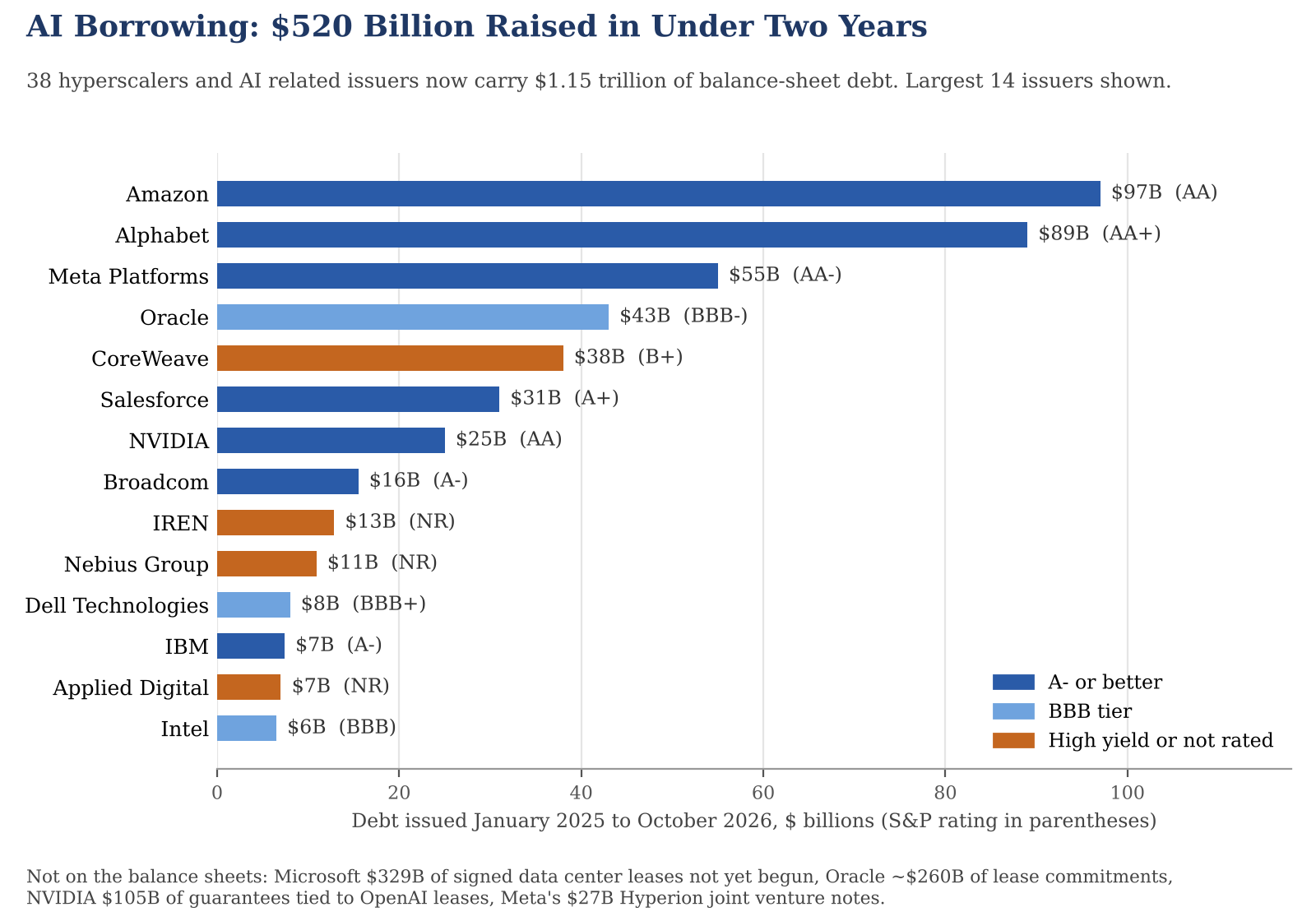
Debt issued by hyperscalers and AI related companies, January 2025 to October 2026, with S&P ratings. Source: CJ Brott, Alliance Financial Group, compiled from company filings and rating agency reports as of October 13, 2026.
Along with market risk the midterm elections gave investors a political reason to sell what they were already selling. Opposition to new data centers became a campaign issue. In Texas, which holds roughly a quarter of the planned data center capacity in the country, the governor-elect campaigned on a moratorium on new permits. Currently it is still a campaign platform rather than a law. But now jittery investors saw the failure of Wednesday’s rally on the election outcome as another reason to sell which accelerated a trend already in place. I believe it is important that currently nothing in the results changes next year’s earnings for the companies that carry the S&P 500.
Two developments would change my view. The first is guidance. If the hyperscalers reduce next year’s capital plans, the earnings case weakens at its foundation. The second is inflation. The ISM services survey shows prices paid at a new high for this cycle, and on Thursday two Fed presidents, Cleveland’s Beth Hammack and Richmond’s Tom Barkin, argued for further rate increases. The fear of a rate increase reaches stock prices well before the increase itself reaches earnings. Thursday’s comments from two Fed presidents may have added to this week’s selling.
Market Technicals
From a technical perspective the market’s momentum remains broken. Distribution began in earnest in June, when the neoclouds peaked. That is when Morgan Stanley’s momentum index for technology stocks began the worst decline in its history. Since June the selling has moved from the weakest AI names to the leaders themselves. But rather than a change in trend this week’s sharp selloff looks to me like a signal that we are late in the repair stage of this correction but not yet finished with it. If true, this is a correction in a long-term rising market. The 200-day moving average of the S&P 500 is still rising, and on Thursday the index closed just above it. As long as that remains true the primary uptrend is intact, even though slowing momentum may flatten its slope in the weeks ahead.
Even so, technically the market remains on tenuous ground. The cause is the debt investors took on to finance their foray into AI. Hedge funds borrowed from Wall Street’s prime brokers, and Bespoke notes that borrowing reached a record share of hedge fund assets at midyear. Prime brokers demand compliance with loan terms and will sell out a position quickly, often into a falling market. A crop of new leveraged ETFs, each built around a different approach to AI investing, must rebalance every day, so they too must sell, usually on the close of the same day prices are falling. Behind them stand the private credit lenders financing GPUs and data centers, and behind those the loans and guarantees AI companies extend to one another to finance expansion. Market participants were willing to ignore this obvious risk until they were not. Panic spreads quickly when investors do not really know what they own. Leverage turns that panic into forced selling.
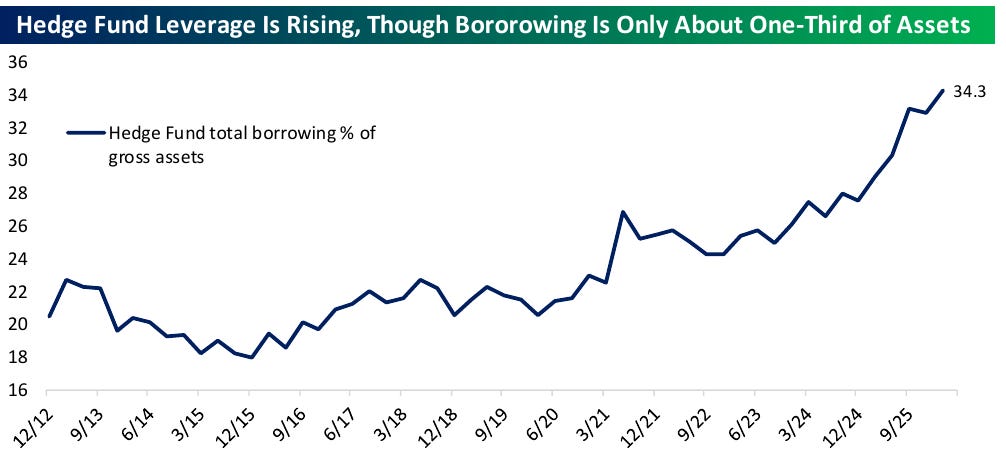
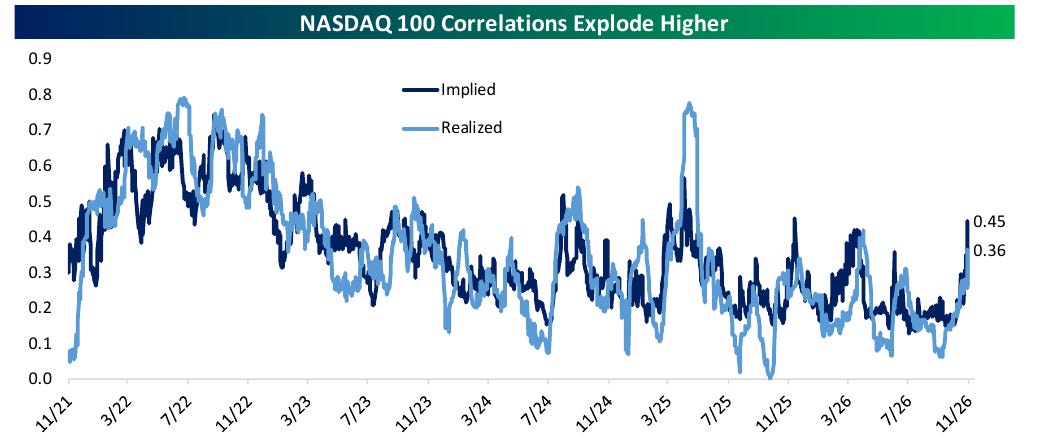
Top: hedge fund borrowing as a percentage of gross assets. Bottom: Nasdaq 100 implied and realized correlations. Source: Bespoke Investment Group.
The mathematics of forced selling has a recognizable character. Stocks stop trading on their own merits and move together, because the seller must raise cash rather than choose what to own. As the chart on the right shows, correlations among Nasdaq 100 stocks jumped this week. Scott Nations argues that major breaks begin when leverage meets a new investment vehicle the market does not yet know how to price. The neoclouds and the AI themed funds launched this year fit that description, and Bespoke shows several of those funds have lost most of the money investors committed to them.
During this near-panic phase of selling in the technology sector the “market of stocks” behaved very differently from the major indices people consider “the stock market”. On Wednesday the equal weighted S&P 500 index closed at a record. Thursday brought a complete reversal in attitude, as the S&P 500 fell more than 4%. While the index fell, almost one member in seven touched a new 52-week high. Bespoke calls that a complete outlier in readings back to 1990 and points out that the equal weighted S&P 500 index held its ground for the week. That is the rotation rather than liquidation I described on October 24. So far the risk unwinding has been confined to the AI trade and has not spread throughout the market.
This has been a particularly difficult time to remain calm. Even though I have constructed models to help me with my investment decisions and portfolio management, markets moving this violently make abiding by their signals emotionally difficult. Partially this stems from the fact that each model has a separate job to do and sometimes my bias wants to override long-term thinking for short-term gain. Still, each has proven accurate, and they need to be used in combination. The longest term model is my Combination Allocator, which blends models of the bond market, stock prices and sentiment. It remains 50% invested. The shorter-term models govern timing, and they are more cautious. The market gate I built on William O’Neil’s count of distribution days places both the S&P 500 and the Nasdaq 100 in correction, and it is 100% out of the market. My Lowry-style model, which measures buying and selling pressure, has been on a reduce and sell since March. It has not yet signaled that the correction is over. The long-term model sets how much I hold in cash reserves. The short-term models tell me when to reduce that cash reserve and buy stocks. Currently I await a buy signal.
What I am waiting for is exhaustion. Paul Desmond of Lowry’s showed that major lows nearly always arrive in panic, with one or more 90% down days followed by a 90% up day, or two back-to-back 80% up days, on heavy volume. Lowry’s measured Thursday as an 85% down day, severe but short of the 90% standard. Friday’s rebound was only a 56% up day, far from the kind of buying that marks a turn. Besides my models, I rely on a simple market measure, the cumulative advance-decline line. As you know I consider a rising cumulative advance-decline line a harbinger of higher prices. If it continues higher while the leaders are still being sold, the market will have confirmed that the damage is contained. If it rolls over, the selling has spread beyond the AI trade and the correction will continue.
Prognostication
My two confirmations, fundamental and technical, agree on direction and differ on timing. The fundamentals answer whether the earnings behind the S&P 500 are at risk, and this quarter they say no. The technicals, including my models, answer when to buy, and they say the liquidation probably has further to run. So, I continue to be cautious for the next several weeks. But I remain confident about the year ahead.
Besides the Fed meeting in December, the event I will watch most closely is the Anthropic initial public offering. The company filed its public registration statement on October 26, and press reports put pricing in the second half of November. Currently no date or price range has been set. Bespoke describes the filing as showing an impressively sustainable business. That makes the offering a test of speculative appetite rather than of business quality. If it prices on schedule and trades well, speculative money is still available. In that case this decline will probably prove to be a violent correction within a continuing bull market. If the IPO is postponed or priced well below expectations, that money is drying up. In that case I will expect a deeper and longer decline, and it would be the first real evidence that this is something larger than a correction.
The models I built are tuned to my own circumstances, and the cash levels they call for may be too high or too low for investors in different financial situations. At forty my own tolerance for risk was very high. I rarely held more than 10% in cash, and I used margin in rising markets. So I understand the appeal of borrowed money when prices only seem to rise, and how quickly it must be repaid when they fall. Today, partly retired, I carry substantial cash and intend to commit part of it as the selling exhausts itself. I may yet be proven wrong, the problem may be larger than leverage. If so, continuing to hold cash will preserve portfolio values.
In closing, please note I believe that over the longer term investors should probably remain invested, with cash reserves sized to their own tolerance for risk. But investors need to remain ready to commit when this liquidation has run its course. And I want to announce my book, Investing in the Second Wave, is now out and has become an Amazon bestseller. It can be found on Amazon and at investinginthesecondwave.com. If you want to understand why a week like this one does not shake my confidence in the companies about to benefit from AI, pick up a copy. I hope you will enjoy it.
CJ Brott
Chairman Emeritus, Capital Ideas
The material presented is for informational purposes only and is believed to be accurate. Sources include but are not limited to publications by FactSet, Dow Jones, Yardeni Research, and Bespoke Investment Group. All expressions of opinion reflect the judgment of the author as of the date of publication and are subject to change. The author may hold positions in securities mentioned in this commentary.