

Market Fundamentals
Start with where the new Chairman started. In his first Jackson Hole address, Kevin Warsh opened not on inflation, not on the labor market, and not on his own principles for the job, but on artificial intelligence. He called this a hinge point in history and described the technology as potentially a new factor of production, which is uncommonly strong language from a sitting Chairman. Then he did two things that belong side by side. He handed the questions that actually matter, whether this produces a sustained rise in productivity and when, whether it complements labor or competes with it, and where the returns finally land, to a task force, and said plainly that its findings will have no bearing on current policy. And he declined to say anything at all about where interest rates are headed. A Chairman who will not forecast rates spent the opening of the most watched speech he will give this year on the technology. He did not endorse the payoff and I will not pretend he did. But the placement was the message, and the questions he left open are the ones this letter has been answering for two years.
He did not need to forecast, because the rest of the world is forecasting for him. Long term yields are rising in the United States, Germany, France, the United Kingdom, Canada, and Australia at the same time. Those six countries have almost nothing in common that bears on this. Their fiscal positions run from disciplined to alarming, their short rates are set by four different central banks, and their politics do not resemble one another. The explanation that fits all six at once is the plain one: more of the world wants to borrow. This is not an inflation scare, since long run inflation expectations have been quiet for years, and it is not a flight from bonds, since the extra compensation investors demand for holding long paper has barely budged. It is the price of capital rising because the demand for capital is rising, which is the precise opposite of the savings glut that every serious economist described after 2008. For fifteen years the complaint was that there was nothing worth funding. Something is now being funded, everywhere at once.
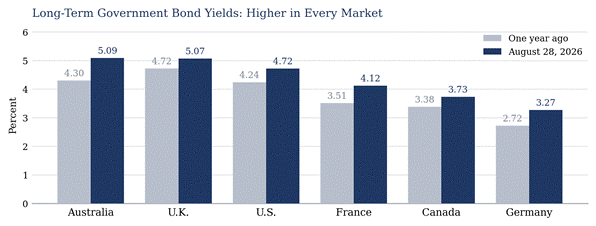
Ten year government bond yields, latest versus twelve months earlier. Source: Trading Economics, August 28, 2026.
This is the fact the bear case cannot absorb. Michael Burry and the Man Group have moved past arguing that the demand for artificial intelligence is fake. Their case now rests on financing mechanics: depreciation schedules that assume a five or six year life for hardware that may last two or three, circular commitments in which one company’s revenue is another company’s capital pledge, lease obligations parked off the balance sheet, and free cash flow compressing across the largest technology companies. I take those seriously and I do not dismiss them. But they are arguments about how the buildout is being paid for, and arguments about financing are settled in the end by growth. Five firms can trade paper with one another. They cannot lift the cost of long term money in six sovereign bond markets at once, and they certainly cannot do it in Ottawa and Canberra.
Al Root made the scale argument in Barron’s this week and it deserves more attention than it got. Looking across 250 years of American capital booms, he finds the economy has absorbed spending on a transformational technology equal to roughly a quarter of a year’s national output before things turn ugly. Railroads were the template: annual output near ten billion dollars in the 1860s against rail spending that eventually totaled two and a half billion before the panic of 1873 arrived. Apply that same yardstick today, with output near thirty trillion, and the danger zone sits somewhere around seven and a half trillion dollars, which is another five to six trillion of domestic spending from here. At the current pace that line does not get crossed until the early 2030s, six or seven years into this boom. I would not lean on the decimal places, since that is Barron’s own construct rather than a standard series, but the order of magnitude is what matters. There is room, and room is time. Time is precisely what converts a buildout financed by other people’s money into one that pays for itself.
What tells me the growth is real is that it does not look like a software story. Japanese machine orders for industrial robots are up 26.4 percent over the past year, the fastest in five years, with machine tool orders accelerating on demand from China and the emerging markets. Korean manufacturing sentiment has reached new cycle highs on memory demand and is spilling into the rest of that economy. Germany’s benchmark index and Sweden’s both closed at records on Friday. Factories in countries that own none of the underlying intellectual property are running harder because of it. That is what a general purpose technology looks like while it is being installed, and it is what electrification looked like between the wars. The dynamos went in during the 1890s and 1900s, and the productivity gains did not arrive until the 1920s, after plants were rebuilt around unit drive instead of a central shaft. I made that argument in my January 2021 letter under the heading of a “Roaring 2020s” and I make it at length in the book this fall. Installation first, integration a decade later. I am watching for the one thing that would change this reading, which is capital spending growth decelerating while the economies around it stall. A worldwide industrial expansion and a technology this consequential arriving together may simply be more than the accountants can stop.
Market Technicals
The tape agrees with the thesis and disagrees with its leadership, and that tension is the most useful thing on my screen. Since earnings season began on July 13, Microsoft and NVIDIA together added roughly 1.41 trillion dollars of market value while the other seventy one Technology stocks in the index lost 22.3 billion dollars combined. Two companies accounted for the entire sector gain. Concentration of that order is a condition rather than a sell signal, but it does mean the index is currently reporting on two balance sheets rather than on an economy. It also sits oddly beside a genuinely broad summer: from May 18 through August 21 the equal weighted S&P gained 9.3 percent against 3.7 percent for the cap weighted index, and then the market re-narrowed violently in the last two weeks of earnings season. Both things are true and I see no reason to resolve the tension. Breadth improved while the leaders rested, and the leaders took it back when they reported.
Beneath the leadership the market is more discriminating than the headlines suggest. Bespoke’s basket of picks and shovels names, the contractors, power providers, and turbine makers levered to the data center buildout, has been in a steady downtrend since April. At the same time, the basket of companies most exposed to being disrupted by this technology, the ones that collapsed in the first quarter on fears that credit reporting and food delivery and office leasing were about to be made obsolete, has recovered every bit of that loss and now trades at its best level since the tariff shock of 2025. Read those together and the market is making a specific judgment: the infrastructure is real, the displacement story was oversold, and the enthusiasm for anything with a data center attached is being rationed.
The week also handed me my standing thesis with a name attached to it. Situational Awareness, a hedge fund carrying what Bespoke fairly called absurd leverage in high beta artificial intelligence names, had to sell its entire public equity book to Citadel in August after that group broke. “Leverage always leverage” is the phrase I keep returning to, and Scott Nations is right that the great breaks in our history trace to new vehicles combined with borrowed money rather than to the underlying idea being wrong. A leveraged fund blowing up inside a theme is not the theme failing. It is the tuition. I am watching the percentage of the S&P 500 above its 200-day moving average, which stood at 72 percent in my August 15 letter with a thrust through 75 percent as the signal I want, along with the cumulative advance-decline line and whether the 200-day is still rising smoothly. What would change my reading is credit. If spreads on the data center and neocloud financing complex widen while investment grade stays calm, that marks this buildout as the source of the stress rather than a passenger in a general risk-off, and I would act on it.
Prognostication
The cost of capital is rising against a capital intensive thesis, and I do not think that ends the thesis. The market moved the odds of a September hike to 57.1 percent on Friday from 35.8 percent the day before, and futures now carry roughly two increases by the spring of 2027 with declines after that. Warsh would not forecast and the market forecast for him. That is a policy rate catching up to a neutral rate the world’s demand for capital has already pushed higher, not a campaign to break the back of demand the way the early 1980s were. Raymond James strategist Tavis McCourt, quoted in the same Barron’s piece, makes the point that these booms rarely die of their own accord and usually need an outside shock to end them, often a central bank. That is the risk worth naming, and I name it. A Federal Reserve that tightens into a capital cycle it does not yet understand is the most plausible way this gets interrupted.
Interrupted is not the same as ended. What has to happen for a capital spending boom to succeed, in McCourt’s own framing, is that the outlays slow while profitability ramps, so the businesses become self-financing. There are early signs of exactly that. Root notes that a gigawatt of computing power costing forty billion dollars to build can generate something close to forty billion in annual sales, against an S&P 500 that needs two to three dollars of assets to produce a dollar of revenue. If those economics hold even approximately, the cash flow arrives before the financing runs out, and the profits follow the cash flow. McCourt is honest that a smooth ramp to profitability without hiccups has never happened at this scale outside of government funded booms, and I will not wave that away. But he is describing a race between growth and financing, which is the right way to frame it, and everything in the global data this week says growth is running well.
So I hold two things at once, which is unfashionable but honest. Near term I expect turbulence, and I would not be surprised or alarmed by a meaningful drawdown given how much of the index now rests on two companies and how much borrowed money is chasing the same theme. Longer term I think we are early in the installation phase of the most important capital cycle since electrification, and a worldwide industrial expansion is supplying the demand that carries it. I will change that view if the hyperscalers shorten the stated useful lives on their hardware, which would validate the depreciation case and reset earnings across the group, if the picks and shovels downtrend spreads to the buyers rather than staying with the sellers, or if capital spending growth slows while the profitability that is supposed to replace it fails to appear. Absent those, the Federal Reserve can raise the price of money. It cannot repeal a capital cycle.
CJ Brott, Chairman Emeritus, Capital Ideas
Data and charts referenced in this letter are drawn from FactSet, Dow Jones, Yardeni Research, Bespoke Investment Group, and Trading Economics. This letter is for informational purposes only and does not constitute investment advice or a recommendation to buy or sell any security. Past performance is not a guarantee of future results.