

CJ’s Weekly Market Memo
November 22, 2026
What could turn calamity into catastrophe? For last week’s stock market, it was three events compounding one another. Investors were already shaken by the continuing failure of the AI trade to support their confidence and their portfolios. Then Nvidia, long considered the bank of AI, gave reason to wonder whether it would keep lending. Its record quarter came with guidance that its interim chief executive said considers “our customers’ access to capital,” in other words their ability to pay. By the end of the week the stock had fallen to a new 52-week low. At the same time Fed officials pronounced the need to raise rates further than the futures market expects. Presumably to slow economic growth and therefore inflation. Governor Christopher Waller called for a half-point increase in December, and St. Louis Fed President Alberto Musalem said the fed funds rate may be as much as a full percentage point below where it needs to be. Finally, with speculative confidence broken and money for risk in short supply, the Anthropic offering came and absorbed the last of the bullish dollars. All of this happened as the major market indices were testing and then breaking below their support levels.
Those of you who have known me long enough understand my belief that market downturns in bull markets end with a rapid decline. This last year has been a slow drip of what appeared to be distribution of winners and rotation into more defensive holdings. It became progressively more apparent from late summer until now. Last week was the first occurrence of what appeared to be panic driven liquidation of all holdings. That included not just technology stocks but recently acquired defensive stocks, and even commodities such as copper and gold. The flight to safety was apparent as the US dollar surged to its highest level in at least a year and Treasury yields fell. The panic was demonstrated by the magnitude of the move in equity market indices and indicators. VIX, Wall Street’s fear gauge, leapt more than 16 points for the week, the eighth largest weekly gain on record. The S&P 500 declined 8.6%, its 12th worst week since 1952, while the Nasdaq 100 fell 10.4%, its 11th worst week since 1985. And the Dow fell more than 8%, falling at least 1% every day of the week. Since WWII, that has happened only once before, the week of October 6th, 2008. This is the type of panic needed to establish a market bottom capable of supporting a lasting rally.
Some of my clients and even my associates have asked me why the selloff before last week was not sufficient to commit the cash reserves raised earlier this year. I have been waiting for the events of last week. I believed in the rotation argument, and from the October high until last week a rising Advance/Decline line supported it. That has crumbled. Not only have prices continued to decline but the A/D line has fallen with them. This is clear evidence of liquidation. My colleagues argued fear had already reached extreme levels in early November. It had, but not deep enough. On Friday CNN’s Fear & Greed Index fell to 10. The other missing ingredient was the panic plunge which normally occurs around the time of market bottoms. Last week may have been it. Bespoke reminds us there is no reliable indicator that tells you a decline has run its course, and that the better measure is usually your stomach. Thanksgiving seems like the right week to consult it. If last week left yours a little unsettled, that may be the best evidence the selling is nearly done.
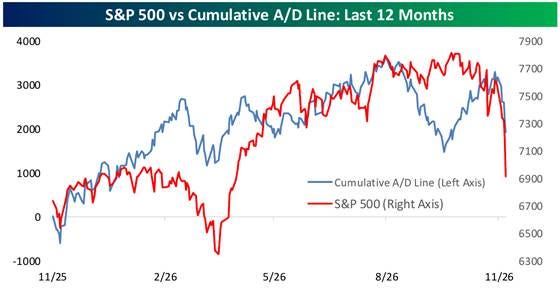
S&P 500 versus its cumulative advance-decline line, last 12 months. Source: Bespoke Investment Group.
During last week’s devastation portfolios sustained significant damage. Since October 6th Nvidia has fallen 47.5%, the S&P tech sector is down 24.7%, and semiconductors are down nearly 40% from their highs. Even after its fall, technology is still about a third of the S&P 500, with Nvidia among its largest holdings. Last week’s damage probably caused sharp declines in 401(k) accounts. Millions of investors own S&P 500 index funds and think of them as diversified. Those holders have had the weekend to assess the damage. I fear Monday may bring the moment many of them finally capitulate, causing one last precipitous slide. The final missing ingredient. Bespoke notes that after the other nine weeks since 1952 when a 3% Friday decline capped a 5% weekly drop, the next trading day was lower seven times. Such a decline would mark the bottom I am hoping for. After that, I believe the market could mount a rally during Thanksgiving week, with its normally subdued volume. The S&P 500 is now 4 standard deviations below its 50-day moving average, the most oversold since August 2015. The stage is set for a powerful yearend rally. My proprietary trading systems still need confirmation. They require at least one powerful thrust to the upside to trigger commitment of cash reserves. I feel strongly that if we are not there, we are very close to that reversal. Happy Thanksgiving!
Nice overview CJ. I hope you're right on the downturn coming to an end. I have faith in your system and projections! Happy Thanksgiving!