

CJ’s Weekly Market Memo
Put Down the Phone
September 26, 2026
The wall of worry has never been taller, and I think most of it is made of noise. Every bull market climbs one, and the adage is old enough that nobody remembers who said it first. What has changed is how the wall gets built. A generation ago the worries arrived once a day on the front page and once a night on the evening news. Today they arrive every few minutes on a phone, sorted by software that has learned alarm keeps us looking, and the habit even has a name: doom scrolling. This week the scroll ran from Iran to the midterms to Kevin Warsh, and the S&P 500 has now fallen on the day of each of his first three meetings as Chair. None of it tells me what the companies in the S&P 500 will earn next year. The signal is corporate earnings, growing at a pace usually seen only coming out of a recession, and a world economy whose purchasing managers keep reporting faster growth. Two weeks ago I let a slowdown in the economic data pull my attention away from that signal. This letter is about separating the two, and the chart below is where I start.
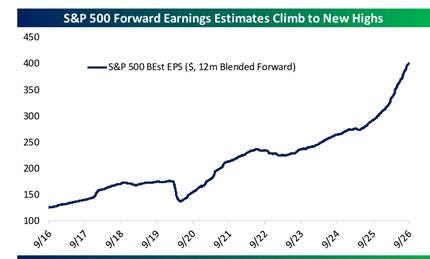
S&P 500 forward twelve-month earnings estimates, 2016 to 2026. Source: Bespoke Investment Group.
Market Fundamentals
Earnings are the signal, and they haven’t wavered. Bespoke puts forward earnings for the S&P 500 about 20% above the trailing twelve months, a spread that is very strong by the standard of recent history, and the estimates are still climbing. In my September 12 letter I leaned on Bespoke’s Matrix of Economic Indicators, which had swung sharply negative over two months, and I read it as the economy slowing beneath the stock market. I gave that reading more weight than it deserved. The Matrix counts how many year-over-year comparisons are improving or deteriorating. A run of hard comparisons can turn it negative while the economy keeps growing, and I believe that is what happened. The flash US Composite PMI from S&P Global rose to 58.4 in September, a 62-month high and the fourth straight month of accelerating activity. Purchasing managers around the world are reporting much the same. So the economy did not stall in June. Its momentum faltered and recovered, and I mistook the falter for a trend.
An expanding world economy needs higher interest rates, and I no longer read the rise in yields as a threat by itself. The doom scroll reads last week’s hike as the Fed choking the recovery. Bespoke’s work points the other way. The climb in the ten-year has come almost entirely from real yields, while long-term inflation expectations sit close to where they’ve been for years. That is the bond market pricing stronger growth, which is exactly what the bond market should do in an expansion. The inflation that remains is coming from bottlenecks. The same PMI report showed order backlogs building, delivery times stretching, and input costs rising, led by fuel and freight. Diesel is the clearest case, and the diesel crack (the premium of diesel over crude) sits at a record. My view is that these bottlenecks prove temporary. High prices are how an economy tells producers to build capacity, and capacity is being built.
I’m watching two things. The third quarter reporting season begins in the middle of October, and the estimates in the chart above have to be confirmed by what companies actually report and what they guide. And I’m watching the bottlenecks. If input costs are still climbing at year end and inflation expectations break out of the range they’ve held, then the rise in rates is about inflation after all, and I’ll have been wrong to call it noise. Bespoke makes the fair point that with profit margins at records, something has to give. With multiples already back in the high teens, the risk in this market sits in earnings. That is where my attention stays.
Market Technicals
My own technical models are still urging caution, and I intend to respect them. The tape is a different category of evidence from a headline. It’s the market’s record of what investors are actually doing with their money, and I weigh it accordingly. The division of labor is simple. The fundamentals tell me whether to own stocks. The tape tells me when to add, and for three months it has said wait. The Lowry-style distribution I described on September 12 hasn’t been repaired. On Monday the S&P 500 rose better than 1% to close within 1% of its high, yet more of its members made new 52-week lows that day than new highs. One newsletter pointed out that the only two prior examples came in July of 1929 and December of 1999. That is the purest doom scroll material I saw all week, and two observations make an anecdote. Still, the condition it describes is real, and it matches the narrowing in my advance-decline work.
The same week brought evidence on the other side. The Nasdaq closed at a record on Monday for the first time since June 2. Bespoke counts thirteen prior stretches of three to twelve months without a record close, none with a decline of more than 15%, and in the month after each one ended the Nasdaq rose. The semiconductors, the group I’ve called the leadership of this cycle, have turned up sharply this month, as the chart below shows. None of that is a buy signal from my models yet. But it’s the kind of evidence Dan Sullivan taught me to take seriously. Sullivan’s observation was that the first 20% or so of any profitable change in direction happens in the first four or five days. Most investors miss it, because they are waiting for confirmation that arrives after the move has been made.
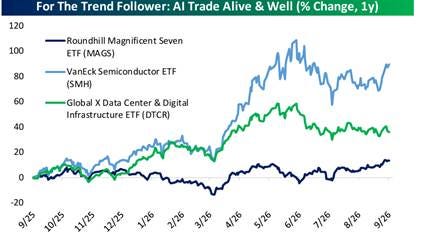
Magnificent Seven (MAGS), semiconductors (SMH), and data center infrastructure (DTCR), one-year change. Source: Bespoke Investment Group.
So I’m more vigilant than usual. What would change the call is a confirmed buy signal from my own models, with the percentage of S&P 500 members above their 200-day average turning back up through 50% and the cumulative advance-decline line rejoining the index. If those arrive, I’ll act within days. If instead the index keeps making highs on fewer and fewer stocks, the distribution process has further to run and my caution stays in place, however good the earnings look. Long experience has taught me that the tape usually knows something before I do.
Prognostication
My two confirmations fundamental and technical are split again, and this time I know which one governs what. The fundamentals are the signal, and they say the earnings behind the S&P 500 are growing fast enough to carry this market through a Fed that’s raising rates into an expanding world economy. The technicals govern timing, and they say the weeks ahead remain unfriendly. So I hold the direction with conviction and the timing with patience. I still expect the low for this move in the middle of October, the call I’ve made in each of the last three letters, and I expect my models to give a buy signal on or around it. When they do, I won’t spend a week debating it. Sullivan’s four or five days are the reason.
I’ve been thinking this week about Everest. The mountain’s most demanding requirements for success are patience, preparation, and the discipline to concentrate on the goal ahead. Climbers wait weeks at base camp for a weather window, acclimatize in stages, and carry a plan for every hour above the last camp. High on the mountain, distraction can be deadly. Investing asks for the same three things, and the doom scroll works against all of them. It makes patience feel like negligence, it turns preparation into reaction, and it pulls attention away from the goal toward whatever arrived on the phone in the last five minutes. For me the signal is still earnings, and my models are the preparation. So put down the phone, watch the earnings, and keep the buy list current. The climbers who reach the summit are the ones who knew what they were waiting for before they left base camp.
CJ Brott
Chairman Emeritus, Capital Ideas
The material presented is for informational purposes only and is believed to be accurate. Sources include but are not limited to publications by FactSet, Dow Jones, Yardeni Research, and Bespoke Investment Group. All expressions of opinion reflect the judgment of the author as of the date of publication and are subject to change. The author may hold positions in securities mentioned in this commentary.