

CJ’s Weekly Market Memo
A Market of Stocks
October 10, 2026
A point of confusion for many investors is the difference between “the stock market” and a market of stocks. When Warren Buffett was getting started in the mid 1950’s there were approximately 6500 publicly traded stocks. In 1970, when I obtained my securities license, the number had grown to about 7000 and rose to 8000 in the 1990’s. Presently that number has declined to about 5500. In other words, the market of stocks has continued to contract, become more concentrated in fewer and larger names whose value has grown faster than share count has fallen. The largest names reside in the S&P 500 index and that is what most people think of when they refer to “the stock market.” Recent letters of mine show a disturbing trend of separation between the two. The index of larger companies has held its gains, and on Tuesday it made a new all-time high, while the majority of non-mega cap stocks have either entered correction territory or worse yet bear market levels. The prevailing reading is that a new high settles the argument. I don’t think it does. This is the conundrum that has me calling for a price correction in the largest names turning their correction in time into the type of sharp pullback that normally ignites significant rallies. The chart below shows how far apart the two have drifted.
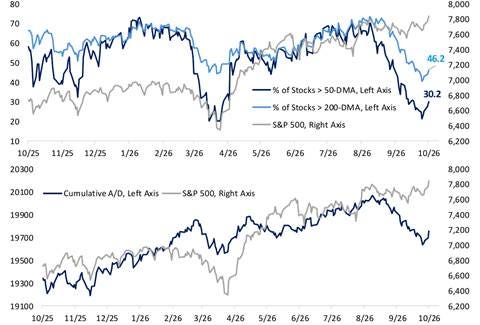
Percentage of S&P 500 members above their 50-day and 200-day moving averages (top) and the cumulative advance-decline line (bottom), each against the S&P 500. Source: Bespoke Investment Group.
Market Technicals
A new high made by a shrinking minority of stocks is a warning, and Tuesday’s was made by the smallest minority on record. Bespoke points out that it was the first time the S&P 500 reached a new high with fewer than a third of its members above their 50-day moving average. The only other time the 50-day and 200-day readings were both below half at a new high was three days in late December 1999. It also came on continuing light volume. Joseph Granville, the showman who in his heyday could move the whole market with a single newsletter, built his On Balance Volume work on the idea that volume leads price. Light volume at a new high tells me the buyers who pushed the index there are fewer and less committed than the headline suggests. It doesn’t tell me when they will stop.
The cumulative advance-decline line is the measure I trust most, and it hasn’t come close to confirming. It peaked in August and remains well below that level, even as the S&P 500 sits above its own. That is the Lowry divergence I have written about since June, the gradual withering of demand that shows up in the advance-decline numbers long before it shows up in the averages. And the leadership is thinner than the popular story. The usual complaint is that the megacaps are carrying the market, but Bespoke shows only four of the thirteen trillion-dollar companies have beaten the S&P 500 this year. Most of them rallied hard enough last week to finish overbought, so the push to a new high was a short sprint by stocks that were already stretched. In Stan Weinstein’s terms, that is the look of distribution, large holders selling into strength, more than accumulation.
What would change my mind is the separation healing from below. If the percentage of S&P 500 members above their 200-day average climbs back over half and the advance-decline line starts back toward its August high, the rest of the market is catching up to the index. I’d then read the last two months as rotation. If instead the index keeps rising while those measures stall, the gap only widens. Gaps like this one have usually closed with the leaders coming down to meet the rest. Still, I’m a strong believer in letting the market tell me what to do, and the tape will speak long before the talking heads do.
Market Fundamentals
The economy is holding up fine. The pressure on this market comes from the cost of money and fuel, and the consumer feels it first. Bespoke’s “three-headed monster” of rising long rates, a strong dollar and expensive oil has kept all three heads up, with the ten-year Treasury yield at its highest level in decades. Those three reach the household through prices. Jobs are plentiful and weekly unemployment claims are about as low as they get, yet consumer sentiment surveys sit near record lows, because nearly everything a family buys or borrows costs more. Bespoke’s “MORTGAS” index adds the price of a gallon of gas to the 30-year mortgage rate, and this week it set a new record. Bespoke expects that to show up at the ballot box next month, and it may. Politics, though, has never been a good reason to trade, and I don’t intend to start now.
That makes this week’s inflation numbers more important than usual. Consumer prices are due midweek, and the forecast already calls for a hot headline month on energy alone. A print above it would push rates higher and feed the strongest of the three heads. A tame one would give the bond market a reason to ease off, and the consumer a reason to feel a little better. Of course, the economy underneath has held up better than the mood of the people living in it. That gap between how consumers feel and what they spend hasn’t failed me yet in this cycle.
This is an AI market, and the bull market behind it turns four years old this week. That makes the earnings reports later this month the real test of the S&P 500 we own today. The trillion-dollar companies begin reporting in the third week of October, and the largest cloud spenders follow in the last week. Bespoke tracks the AI trade in two baskets, the companies building the technology and the companies putting it to work, and the gap between them is the most telling chart in this week’s report. The builders are up by about 78% this year. The users are up barely 1.5%.

Bespoke AI Infrastructure and AI Implementation baskets versus the equal weighted S&P 500 and Nasdaq 100, year to date through October 8. Source: Bespoke Investment Group.
That gap is the subject of my book, “Investing in the Second Wave,” which comes out this fall. Electrification is the parallel I lean on. America built its power plants and transmission lines first. The larger payoff came later, after factory owners redesigned their plants around the electric motor, and that took the better part of two decades. The first wave is the buildout, and the stock market has paid for it handsomely. The second wave is implementation, when the companies using the technology start showing it in their margins, and the stock market hasn’t paid for that yet. I’m watching for the implementation basket to start pulling its weight, because that is how the separation between the stock market and the market of stocks closes from below. If instead the largest spenders trim their capital plans in late October, the first wave stalls before the second has begun, and I’ll rethink the timetable.
Prognostication
My two confirmations, fundamental and technical, disagree this week, so each gets its own question. The technicals own the timing, and they say the largest names are vulnerable to a sharp pullback. The fundamentals own the destination, and they say the earnings behind the S&P 500 aren’t at risk. I’ll admit the breadth comparison worries me, possibly more than it should. The only time I’ve seen a new high this thin was December 1999, and I acted on it. I sold early. The dot-com stocks went on rising for another three months. It took an added trigger to end that market: by early 2000 the yield curve had inverted, with short-term rates above long-term rates, the bond market’s way of saying the Fed had tightened too far.
That trigger isn’t present this time. The economy is strong, and S&P 500 earnings are expected to grow better than 25% for a third straight quarter. The only thing remotely similar I can find is in Europe. Bespoke notes that French government bond spreads are still extremely wide by historical standards. If French rates were to blow out, the strain could reach the euro itself, since Germany and France are the only two economic powers holding the currency together. A split in the euro is the type of black swan event that could turn a pullback into something much worse. I’d be foolish, though, to risk an entire portfolio on it.
Bull markets don’t die of old age, the adage goes, and Bespoke’s history mostly agrees. Bull markets that reached their fourth birthday have historically gained a median of nearly 17% over the following year. The adage assumes nothing comes along to kill them. The two that ended shortly after this point, in 1961 and 1946, fell about 20%, and in both cases something did.
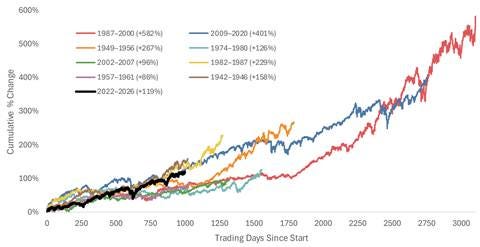
Cumulative S&P 500 gain in the longest bull markets since 1928, by trading days since the start. The current bull market is in black. Source: Bespoke Investment Group.
In my last letter I expected a washout within two weeks and a mid-October low. The index made a new high instead. My thought process has relied on experience and to an extent seasonal factors. I now believe that if that sharp selloff is to come it will be later in October, as that is when most earnings announcements for the highest value S&P 500 stocks, those whose market value is one trillion dollars and above, will be made. Analysts have raised earnings and guidance numbers for these and most AI related stocks continuously, leaving them with a high bar to overcome. That is the core of the potential risk to these stock prices. Any doubt about their future will likely be met, as it was for the OpenAI news article this week, with a sharp, sudden and terrifying drop in price. That article was later reported to be inaccurate, which says a good deal about how little it takes. Should that not happen I will have been wrong and my caution excessive.
So I’m a buyer of that pullback if it comes, and not a seller ahead of it. My list for the next three weeks is short: this week’s inflation numbers, the trillion-dollar reports and the cloud spenders’ capital plans, and the advance-decline line turning back toward its August high. I’d add any sign that the implementation companies are starting to earn their keep. Until those show up I intend to keep my buy list current and stay invested and diversified. The stock market made its new high on Tuesday. The market of stocks is the one I’m waiting on.
CJ Brott
Chairman Emeritus, Capital Ideas
The material presented is for informational purposes only and is believed to be accurate. Sources include but are not limited to publications by FactSet, Dow Jones, Yardeni Research, and Bespoke Investment Group. All expressions of opinion reflect the judgment of the author as of the date of publication and are subject to change. The author may hold positions in securities mentioned in this commentary.