

CJ’s Weekly Market Memo
Fright Night
October 3, 2026
September is usually the warm-up, and October is fright night. I have said some version of that to clients for longer than most of the younger ones have been investing, and I expect this October to keep the tradition alive. The S&P 500 finished September a fraction of a percent lower and sits within a couple of percent of its August 13 high. That makes the last seven weeks a “correction in time” for the index. For the average stock it has been a correction in price, and a severe one. The prevailing reading of that gap is that the index will follow the average stock lower, and the bears say it will keep going lower. I agree with the first half of that. I think the big cap members of the S&P 500 will finally participate in this broad decline, most likely in a short and frightening washout, possibly in the next two weeks. If I am correct, that washout sets the stage for a mid-October turn that carries into late 2026 and early 2027. The tape governs my timing, and it says the worst is probably still ahead. The fundamentals govern whether the earnings behind the S&P 500 are at risk, and the economy says they are not. The chart below shows the washout already underway in the average stock.
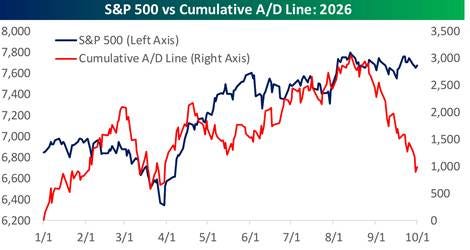
S&P 500 versus the cumulative advance-decline line, 2026. Source: Bespoke Investment Group.
Market Technicals
The average stock has already had its bear market, and the S&P 500 has not. Since the middle of August the advance-decline line has fallen hard while the index moved sideways. That is the Lowry divergence I have been describing since June, and it has run further than I expected. In my September 12 letter I said that if fewer than 40% of S&P 500 members held above their 200-day average, the process was further along than I thought. Bespoke has it right at 40% this week, so I’ll treat the line as crossed. I read that as confirmation. Weakness spreading this broadly in late September and early October raises the odds that a capitulation selloff is coming, and soon. A decline that has gone this far usually needs a final capitulation, and the capitulation generally comes in the stocks that held up the longest, the large cap S&P stocks.
The strongest sign that the end is near is how much damage is already done. More than half the stocks in the S&P 500 are oversold, a reading usually seen near the end of steep corrections. Paul Desmond of Lowry’s found that major lows nearly always arrive in panic: one or more 90% down days followed by a 90% up day, or two back-to-back 80% up days, all on heavy volume. A market this stretched needs very little to finish the job. One more sharp push lower that pulls the mega caps and the semiconductors down with everything else would do it, and the rally that follows a washout like that is usually as violent as the decline before it. It won’t be pleasant to sit through, and it could be genuinely frightening for a few days.
The stocks most at risk now are the leaders. In my September 19 letter I said the semiconductors clearing their 50-day average would rally the Nasdaq, and on Friday the Nasdaq 100 closed at a record. I read that as the market still dependent on its strongest hands, which is exactly why I expect the washout to reach them before the market bottoms. If the percentage of S&P 500 members above the 200-day stops falling and turns up without a washout, I’ll have been wrong about the timing. Long experience has taught me that the tape will tell me which. It will speak long before the talking heads.
Market Fundamentals
The news is glum, and last week I told you to put down the phone. It bears repeating, because the conditions pricing this market lower can turn without warning. Bespoke calls them the “three-headed monster”: oil, interest rates and the dollar moving against stocks together. All three heads climbed through September, and long Treasury yields reached their highest level since 2007. Then on Friday a weak jobs report, along with a G-7 agreement to release emergency oil and diesel stockpiles, eased the pressure on all three, and the odds of another Fed hike in October fell sharply. One day doesn’t make a trend, and a stockpile release doesn’t end a war. But Bespoke itself calls the monster stretched and due for a pullback, and in my experience extremes in the monster and extremes in breadth tend to unwind at about the same time.
The risk on the other side is inflation. Manufacturers reported last week that they’re paying more for materials than at any time since spring, and that’s exactly what the Warsh Fed is watching. A softer job market argues for the Fed to sit still while rising prices argue against it, and the bond market will spend October deciding which matters more.
Underneath the noise, the earnings that carry the S&P 500 haven’t flinched. Profit margins are at a record, and the companies doing the heaviest lifting pay for their spending out of cash, which is why I argued two weeks ago that higher rates can pressure these stocks for a while without reaching the earnings underneath them. Consumer stocks have been hit hard even though household balance sheets look as healthy as they have in decades. I read that as the stock market pricing in a slower consumer, and Friday’s report agrees. What would change my mind is credit. Junk bond spreads have started to widen, meaning their yields are rising faster than Treasury yields, led by the weakest borrowers. If that widening spreads to better quality credits in October, the washout I expect becomes something larger, and I’ll position accordingly.
Prognostication
My two confirmations, fundamental and technical, split this week, and each has its own job. The tape owns the timing, and it says the decline isn’t finished. The fundamentals own the destination, and they say the earnings behind the S&P 500 are intact and the pressure from oil, rates and the dollar is closer to its end than its beginning. So I hold the call on direction with conviction. The breadth break makes the selloff more likely, though the market will decide whether it ends in mid-October or takes a little longer. I’m a buyer into that washout, and I’d rather be early by a week than late by ten percent.
I owe readers a plain admission about where the mid-October date comes from. It is mostly personal experience. I have watched markets since 1970, and the mid-October low has shown up often enough over those years that I learned to plan around it long before I could explain it. The lows of 1987, 1990, 1998, 2002, 2011 and 2022 all came in October, most of them near the middle of the month, from six entirely different causes. I’ve said before that I wouldn’t bet a portfolio on a date, and I still wouldn’t. But I’ve been right about this rhythm far more often than not, and my misses have usually been measured in weeks. I like to say that September is the warm-up for October’s fright night. The fright is real. The panic is usually set off by something nobody saw coming. When it arrives after most sellers have already sold, the conditions for a strong rally fall into place. Most investors are tricked by the panic, which usually ends before Halloween, and the buyers who stepped in collect the treat.
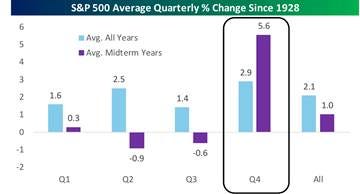
S&P 500 average quarterly change, all years versus midterm years, since 1928. Source: Bespoke Investment Group.
This year may hold a particularly good treat. Since 1928 the fourth quarter of a midterm election year has been one of the strongest stretches of the four-year cycle, and the year that follows has historically been the best of the four. I wouldn’t lean on seasonals by themselves. They do line up with what I believe about the decade: the artificial intelligence buildout is still in its installation phase, and the payoff in productivity and profits is ahead of us.
My list for the next three weeks is short. First, the washout itself: a day or two of broad, ugly selling that finally reaches the mega caps, followed by a day when nearly everything rises together. Then the percentage of S&P 500 members above their 200-day average has to stop falling and turn up. Lower oil and a ten-year Treasury back below five percent would help, and junk bond spreads need to stop widening. If mid-October passes with breadth still sliding and no washout to show for it, I’ll have been wrong on the timing. Until then I intend to keep my buy list current and put money to work into weakness, because the all clear never sounds until prices have already recovered. Put down the phone, stay invested, stay diversified. Stay for the treat, and don’t be fooled by the trick.
CJ Brott
Chairman Emeritus, Capital Ideas
The material presented is for informational purposes only and is believed to be accurate. Sources include but are not limited to publications by FactSet, Dow Jones, Yardeni Research, and Bespoke Investment Group. All expressions of opinion reflect the judgment of the author as of the date of publication and are subject to change. The author may hold positions in securities mentioned in this commentary.