

CJ’s Weekly Market Memo
Don’t Just Do Something, Stand There
September 5, 2026
The chart below is the reason I am not selling into this dull, narrowing market. Bespoke has tracked the Nasdaq since the release of ChatGPT against the Nasdaq after the release of the Netscape browser in 1994, and the two lines have stayed remarkably close for almost four years. By their count we are now at September 14, 1998. That was the fall of the Asian crisis and the collapse of Long-Term Capital Management, a frightening leverage unwind that took the Nasdaq down hard into October. The eighteen months that followed were the strongest of the entire decade. The question this letter tries to answer is why the market should repeat that pattern rather than break from it. My answer comes in two parts. Technically, what I see is a “correction in time” inside a trend that is still intact. Fundamentally, the growth ahead from the adoption of artificial intelligence is larger than the market is giving it credit for, and it has barely started. Long time readers know I am most confident when those two sets of tools agree. This week they mostly do on the long view and do not yet on the short one, which is why my advice is patience.
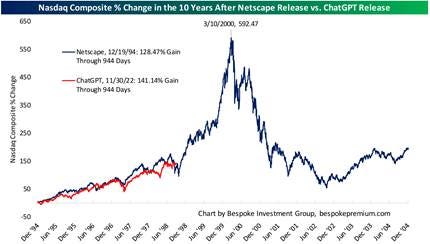
Source: Bespoke Investment Group, The Bespoke Report, September 4, 2026.
Market Technicals
The 1998 correction was caused by leverage, not by any failure of the technology, and that is the first thing the present tape has in common with it. Leverage always leverage, as Scott Nations’ five crashes remind us. This cycle’s leverage flush so far was Situational Awareness in August, and the Nasdaq has been calmer since it left the market. If a bigger one is coming it will show up first in credit spreads and the St. Louis Fed’s stress index, and neither is saying anything alarming. The 200-day moving average is still rising smoothly, so on trend I remain a bull. What I see underneath is the market resting. The S&P 500 is within half a percent of its high, but the percentage of stocks above their 50-day moving average fell below 50% on Tuesday for the first time since May, and the cumulative advance-decline line has more ground to make up than price does. Bespoke thinks this divergence now only reflects the strength of the biggest companies. I am less relaxed about it, because the weakness sits in the leaders. The semiconductors, which I have long called “the transports of the 21st century,” and the actual Dow Transports are both in downtrends of lower highs dating to June.
The rotation out of the industrials is the clearest example of a correction in time, and also of how confusing this market is to read. Industrials made new highs in mid August and then broke below the 50-day without stopping until they neared the 200-day. Bespoke sorted the sector by each stock’s correlation to Nvidia over the past two years. The industrials least tied to Nvidia barely fell. The ones that trade with it, the electrical equipment, cooling, and power companies building the data centers, fell about 12%. So the strongest part of the economy is the part of the sector being sold hardest. That is not a verdict on the buildout. It is a crowded trade being trimmed while investors wait to see whether the companies buying all that equipment will earn a return on it. The same thing happened to the technology sector for eighteen months in 2020 and 2021, and it resolved with new highs. Bespoke’s “three-headed monster” of the dollar, oil, and the 10-year yield explains why the rest has to wait. The dollar has gone back into its cave. Oil and rates have not, and the market will not make its next leg higher until one of them joins the dollar. Sentiment is split the same way: individual investors are scared with AAII bears well above average while price sits near a record, which by my reading is fuel, and the professionals look complacent. This is the “exhaustion” I described last November, when neither side could hold a conviction until a catalyst arrived. I am watching the equal weight S&P 500, which ended the week on its 50-day at the bottom of its uptrend channel. If it breaks that channel while the advance-decline line makes a lower low, that is a correction in price, not time, and I will say so. If a mild inflation report brings breadth back above 50% and the semiconductors break their downtrend, the tape confirms the long view and I will get more aggressive.
Market Fundamentals
The Fed is the near term risk to the pattern and the economy is the long term reason it holds. Last week I wrote about the question Chairman Warsh left open at Jackson Hole. This week Governor Waller answered half of it: he will vote to hold if the August inflation report on September 11 shows continued progress, and consider a hike if it comes in hot. Then Friday’s payroll report came in at about three times what economists expected and the odds of a hike went back to a coin flip. Marty Zweig’s first rule is don’t fight the Fed, and I have followed it for fifty years. But the Fed has not moved. It has held rates at a level Waller calls only slightly restrictive for five straight meetings, and the year I keep coming back to is 1994, when Greenspan began raising rates into an accelerating economy, the market went nowhere for a year, and 1995 became one of the best years in history because the strength that caused the hikes was real. A hike into strength is a delay. A hike into weakness is a danger. If inflation comes in hot, the Fed hikes, and the 10-year Treasury moves through 5%, the pattern gets a real test. If inflation cools and Waller’s hold carries, the near term risk goes away.
The economy underneath the Fed debate has one very strong engine and several idling ones. Dell, Hewlett Packard Enterprise, and Broadcom all reported this week and each said the same thing: demand for AI servers and chips is running well ahead of plan. Data center construction has passed the peak office construction reached in 2020 while nearly every other kind of building has been sliding since 2024. Bespoke’s AI baskets show the same split. The infrastructure basket, the companies selling the equipment, is up over 60% this year, and the implementation basket, the companies that are supposed to use AI to make money, is roughly flat. The Wells Fargo chart below shows why that gap matters. AI capital spending as a share of the economy is already the largest since the railroads of 1865 to 1890, and the railroad boom produced the fastest fifty years of income growth in American history because it lowered the cost of moving goods and moving information at the same time. That payoff came from adoption, from what the country did with the railroads once they were built. The growth ahead from AI is the same kind, and it only arrives with implementation. What no one can tell you is the lag. The electric motor was in factories in the 1880s and did not change productivity until the assembly line in the 1910s. The market is pricing the buildout as if the lag were knowable, and it is not, which is exactly why the implementation names are flat and the equipment names are being trimmed. I am watching for the first quarter in which the implementation basket outperforms the infrastructure basket on earnings rather than on rotation. That will tell me the payoff has begun.
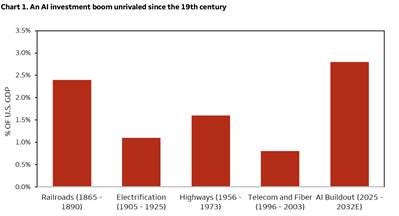
Source: Wells Fargo Investment Institute, “Can AI help pay America’s bills?”, September 3, 2026.
Prognostication
This week I sat with a client whose money I have managed for several decades. He had been shown an investment proposal by another firm. It was complicated, it called for major changes, and it was not suited to his temperament. He turned it down, and I told him he was right to. In the 1970s Richard Russell, who wrote the Dow Theory Letters for more than fifty years, used to say “don’t just do something, stand there.” He meant that most of the damage investors do to themselves comes from acting during dull stretches because doing nothing feels like neglect. I have been in this business since 1970, and a flat market with the Fed undecided and breadth narrowing is exactly the stretch Russell was talking about. The temptation to rearrange a portfolio is strongest when nothing is happening. The right response is to know what you own, know why you own it, and wait for the market to tell you something.
The calendar agrees. September is the only month that has averaged a loss of more than 1% since 1928, but in the 36 years when the S&P 500 was already up more than 10% through August, the last four months averaged a gain of 4.7% with gains in 30 of them, and midterm years add a second tailwind. My base case is that the standoff lasts through the Fed meeting and resolves during October earnings, when the companies building the second wave report again. I expect the S&P 500 to finish 2026 higher than it is today, with the equal weight index and value stocks leading and the semiconductors needing a rest before they lead again. The valuation objection is real, with the S&P dividend yield below 1% for the first time since 2001 while the 10-year pays nearly 5%. The 1990s answer to that objection was earnings growth, and it is the same answer now. For early 2027 the question becomes whether the implementation companies begin to show the payoff, and that is the year I expect the first real evidence. What I am watching next: the inflation report on September 11, the Fed decision on September 16, the equal weight channel, and whether the semiconductors and the transports break their downtrends. What would change my mind is all three together: a rate hike, a 10-year yield through 5%, and a breakdown in breadth. Any one alone is noise. Until then, stay invested, stay diversified, and don’t just do something, stand there.
CJ Brott
Chairman Emeritus, Capital Ideas
The material presented is for informational purposes only and is believed to be accurate. Sources include but are not limited to publications by FactSet, Dow Jones, Yardeni Research, and Bespoke Investment Group. All expressions of opinion reflect the judgment of the author as of the date of publication and are subject to change. The author may hold securities mentioned in this commentary. This memo does not constitute investment advice, and readers should consult with their financial advisors before making investment decisions.